The challenge
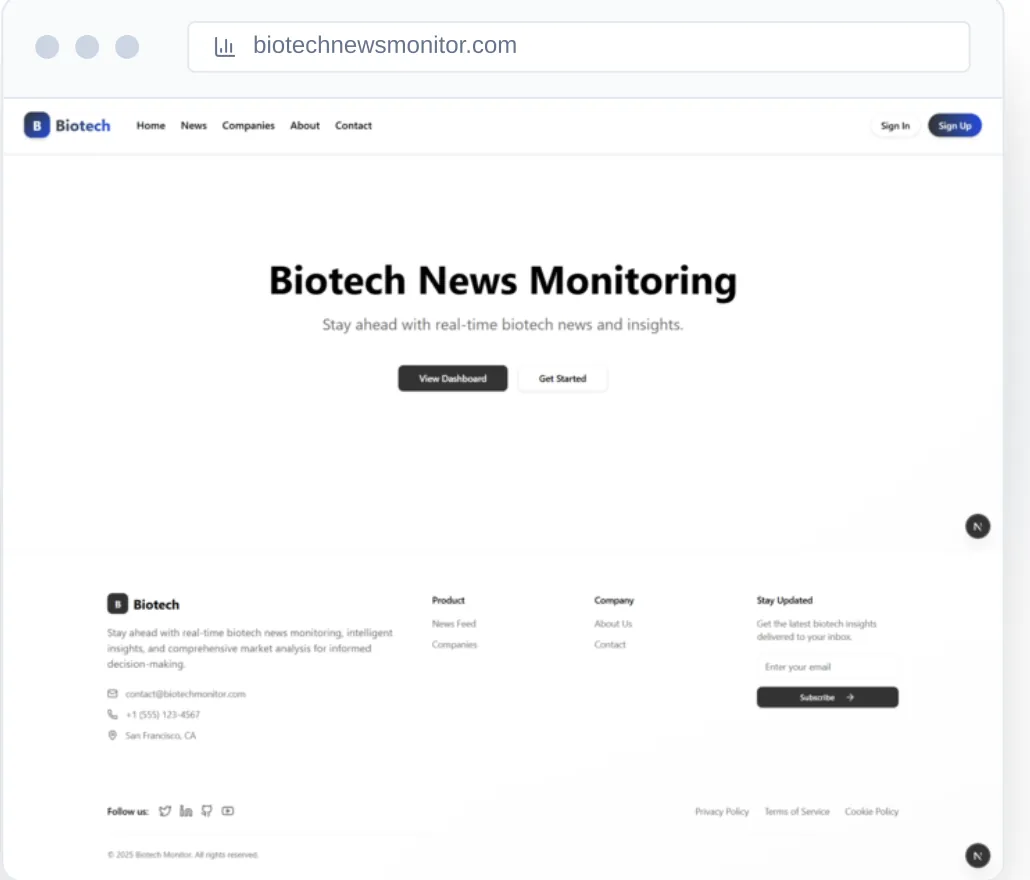
In biotech, a single regulatory decision or trial readout can reprice a company. Those items rarely arrive alone. They come wrapped in press releases, syndicated copies and opinion pieces. The product exists to tackle that information toxicity, and the problem it causes is simple: by the time someone has read enough to find the story that counts, the market has often moved on.
The usual workarounds fall short. Reading everything by hand does not hold up for a team watching a whole sector, and keyword alerts trigger on every mention whether it matters or not. Users needed stories ranked by materiality, presented in a consistent structure and delivered as alerts, so that a whole team could work from one filtered view.
Putting LLMs at the heart of that ranking brings design questions of its own. Each model call adds delay and cost, providers have outages and differ in what they do well, and a breaking story may be opened by many users at almost the same moment.
- Bring real-time sources together in a single feed
- Rank items by sentiment and materiality instead of keyword hits
- Get FDA, trial and ticker-moving stories to users ahead of reactive trades
- Keep model-driven responses fast when many users open the same story
Our approach
We built a full-stack Next.js product. The interface uses Next.js 15 with the App Router and React 19, styled with Tailwind v4 and shadcn/ui, while Redux Toolkit and RTK Query look after server data and app state in the dashboards. On the server, Node 22+ works with MongoDB through Mongoose, and NextAuth.js handles sign-in. Keeping both halves in one TypeScript codebase means a change to a data shape can be made end to end in one place.
The most important decision was not to tie the product to one model vendor. We wrote a custom AI orchestration layer that sits between the scoring logic and OpenAI, Anthropic and OpenRouter. The scoring rules live in one place, and the product is shielded from any single provider’s outage or price change. For a product whose value depends on speed, that independence is a commercial safeguard as much as a technical one.
In front of the orchestration layer we placed a short-TTL cache. When a story breaks and many users open it together, most of them get the cached score straight away instead of each triggering a model call. The expiry is deliberately short, because a news score loses value quickly. This gave the platform the low-latency, enterprise-style access it needed while keeping model spend under control.
Scored items land in structured, alertable dashboards designed for teams. Nodemailer and a Notion integration take alerts and data to where the team already works, so the right person hears about a material story without watching a screen all day.
- Aggregation of real-time news sources
- Sentiment and materiality scoring with LLMs
- Custom orchestration over OpenAI, Anthropic and OpenRouter
- Short-TTL cache ahead of every model call
- Structured, alertable dashboards for teams
- Nodemailer and Notion for alerts and data
Architecture & stack
- Front end
- Next.js 15 (App Router), React 19, TypeScript, Tailwind v4, shadcn/ui, Redux Toolkit / RTK Query
- Back end & data
- Node 22+, MongoDB, Mongoose, NextAuth.js
- AI
- Custom AI orchestration layer, OpenAI, Anthropic, OpenRouter, Short-TTL cache
- Notifications & integrations
- Nodemailer, Notion
The outcome
Users work from a ranked feed instead of a raw one. FDA decisions, trial updates and other ticker-moving items are scored and surfaced with alerts, so investors and researchers can act ahead of reactive trades instead of reading about the move afterwards.
The product can move between AI providers without a rebuild, and the cache keeps it responsive when attention converges on one story. Teams share a single structured view, which replaces the private reading lists and alert rules each person would otherwise keep.
Our advice for any LLM product is to settle three questions early: where the model calls sit, what happens when a provider is slow or down, and how latency and cost will be controlled as usage grows. They are cheap decisions at the design stage and expensive ones after launch. This platform was designed with an answer to each.
Last updated