The challenge
On TikTok Shop, timing is most of the game. Brands and creators need to know which products and formats are rising and why they work. Done by hand, that research means long sessions in the feed, links saved for later, videos rewatched to note the hook, and new ideas tested on instinct. Picking the right creator for each product adds another round of guesswork.
The information is out there, spread over product listings, affiliate videos and engagement counts that never stop moving, and there is far more of it than anyone can review. The usual result is analysis paralysis: endless content and no dependable way to choose the next video or partner. Speed matters as well, because a trend spotted by hand is often past its peak before anyone acts on it.
- Pull in products and their affiliate videos, with metadata, at volume
- Rank content by live engagement rather than feed luck
- Make videos easy to read and compare through transcription and ROI views
- Replace the scroll-and-test routine with AI scripts and creator matching
Our approach
We split Viralzy into two systems with different jobs. A Python data platform collects and processes content, and a Next.js product presents the results. Collection runs in the background while the dashboards people use stay quick, and each side can be scaled or changed without disturbing the other.
For collection, scrapers and workers find products, fetch the affiliate videos attached to them and pull out rich metadata, at scale. Django provides the application layer, PostgreSQL the durable storage and Redis the queues that hand jobs to workers. We chose a queue-based design because scraping is unpredictable: one slow page should not hold up the rest of the batch, and when the client needs more throughput, the answer is more workers rather than a redesign.
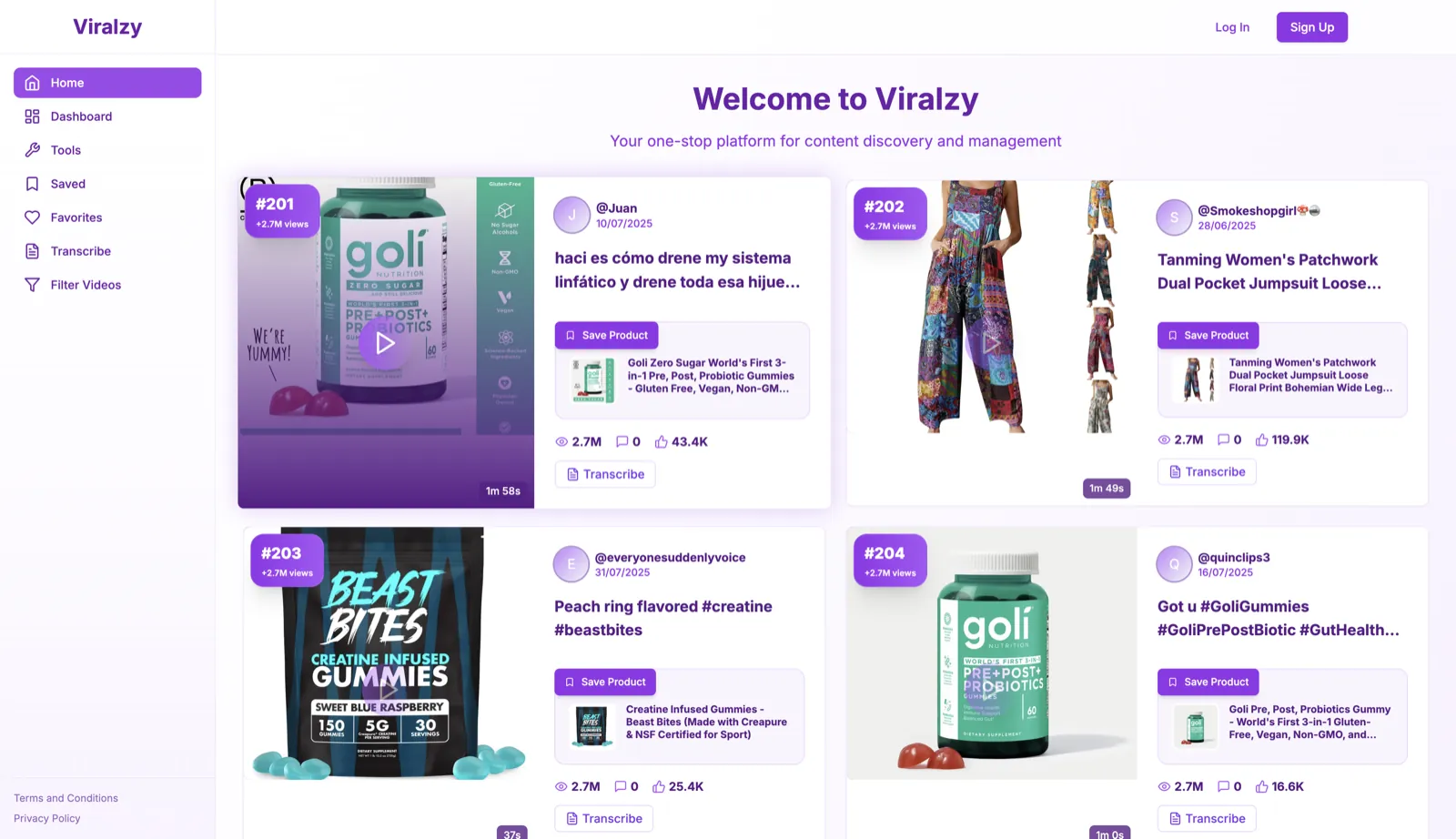
On top of that data, discovery feeds rank viral posts by live engagement signals, putting what is gaining momentum now ahead of what peaked some time ago. Transcription gives every video a written version that can be skimmed and compared, and ROI views set performance figures beside the content, so users are not guessing at what is worth following. Products can be saved to revisit later.
The AI features close the gap between research and production. Script generation drafts scripts for new videos, and AI matchmaking pairs products with creators who suit them, taking the place of manual scrolling and testing. The front end uses Next.js and React with TypeScript and Tailwind, and serves SEO-friendly dashboards.
- Queue-driven scrapers and workers for products, affiliate videos and metadata
- Django, PostgreSQL and Redis for application, storage and queues
- Discovery feeds ordered by live engagement
- Transcripts and ROI views alongside each video
- AI script generation and product-to-creator matching
- SEO-friendly dashboards in Next.js and React
Architecture & stack
- Front end
- Next.js, React, TypeScript, Tailwind CSS
- Back end & data
- Python, Django, PostgreSQL, Redis
- Data collection
- Scrapers, Background workers, Queues
- AI
- Transcription, Script generation, Creator matchmaking
The outcome
TikTok Shop teams now have one place to spot viral affiliate content, understand what makes it work and choose the next step. Ranked feeds, transcripts and ROI views stand in for the scrolling routine, and AI scripts and creator matches turn that research directly into the next brief.
The bigger change is consistency. Content and creator decisions follow the same repeatable workflow each time, based on collected data instead of whoever happened to scroll past the right clip, and a new team member can follow that workflow without inventing their own research habits.
For clients building any product on scraped or third-party data, our first recommendation is the one that shaped Viralzy: keep collection and processing on queues, apart from the application users touch. That boundary lets data volume grow while the dashboards stay fast, and it is far easier to design in at the start than to add later.
“They acted as true collaborators who cared about the success of the product as much as I did.”
Last updated